

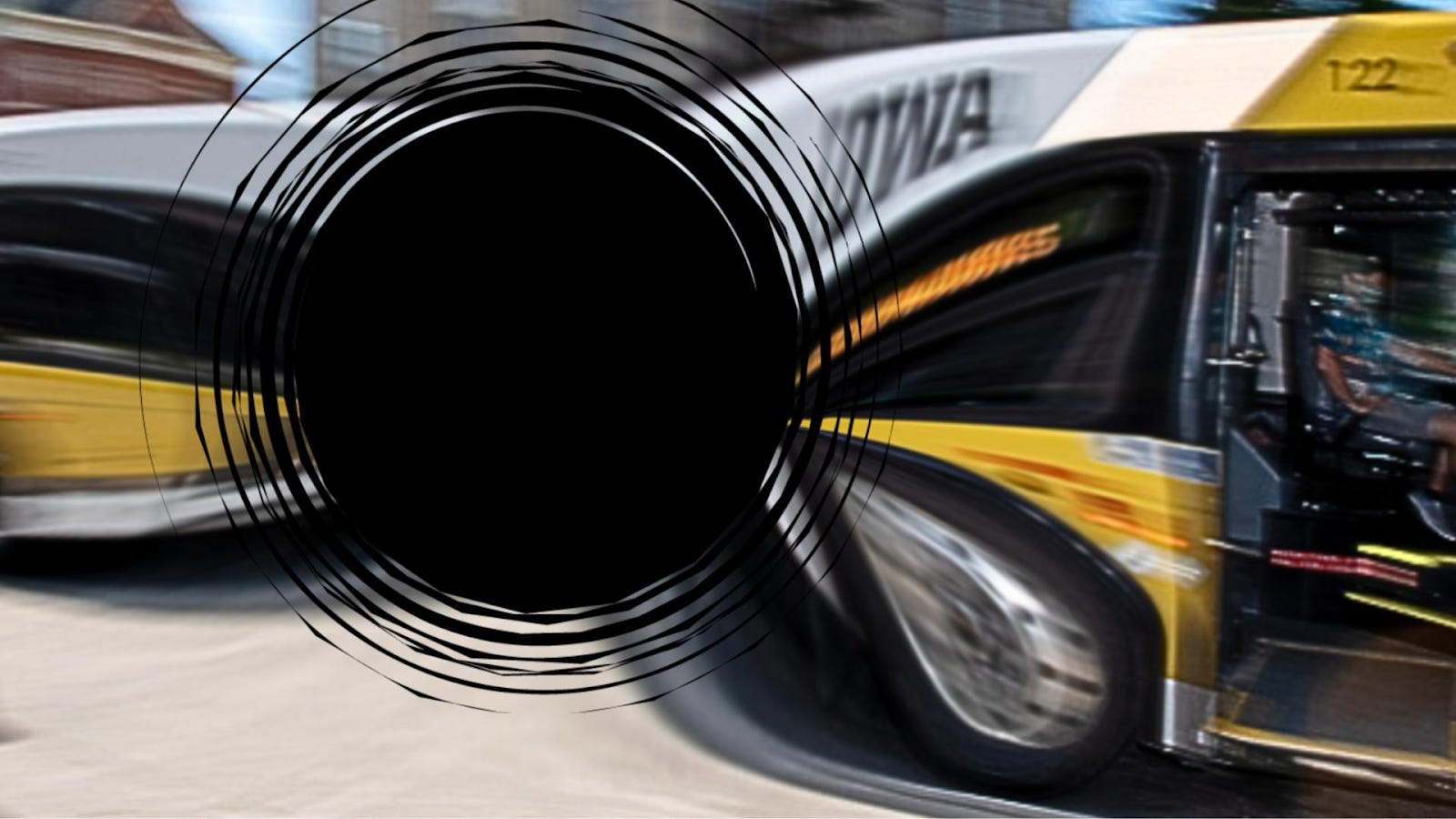
This morning, tragedy struck in front of the Currier CAMBUS stop as a bus on 35 interdorm route collapsed into a black hole. Reportedly, the bus just kept letting people on, even when it seemed like it was at capacity. Students were packed so closely together that it is believed many students were crushed even before the bus reached a critical mass.
We here at the Doily reached out to Dr. Sam Smith from the University of Chicago Physics Dept. for an estimate on how many people it takes for a CAMBUS to collapse into a black hole. Here is the work he provided.
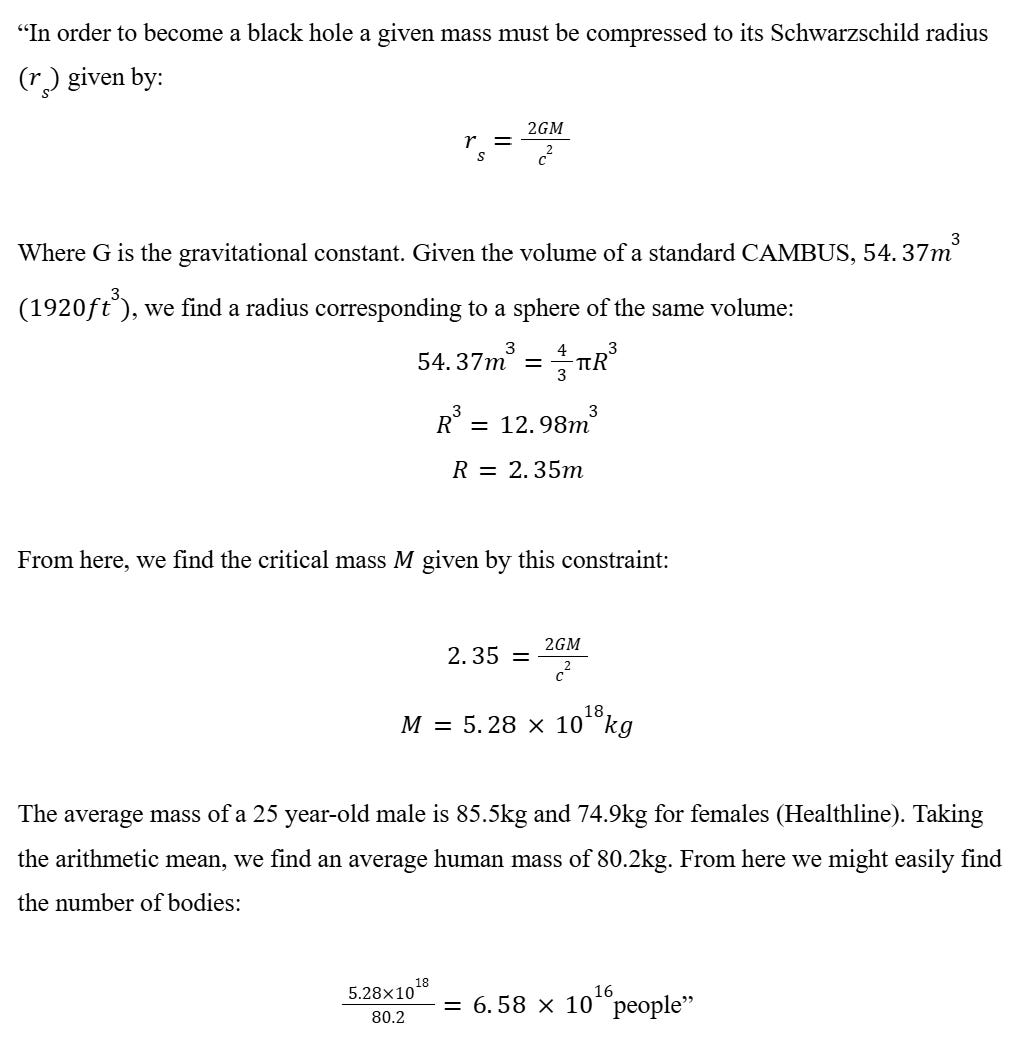
These estimates suggest that there were more people on the bus than the combined enrollment at the University, and potentially more people than there are on the Earth. We are still running those numbers, though. However, Dr. Smith cautions that their calculations did not account for additional mass, such as the backpacks of the students, their cell phones, or the severe emotional baggage they were carrying.
When reached for comment, representatives from CAMBUS emphasized that overcrowding is very common during peak hours: “This space-time rupture remains outside of our standard operating expectations. In the future we want to remind students to move to the back, but in a way that does not accelerate gravitational collapse.”
Witnesses described the moment of collapse as a normal stop requested chime but much deeper. Students near the rear exit door appeared to experience time dilation. At the same time, students near the front door fell victim to the event horizon, no longer being able to escape the doomed bus.
Physics faculty confirmed that once the event horizon formed around the driver’s seat, all of their pleas of “please keep moving to the back of the bus!” became unheard throughout the bus.
Despite the incident, the CAMBUS continues to operate uninterrupted. However, it was noted that when the next bus reached Currier Hall, it was immediately absorbed into the black hole.
It is predicted that the Hawking radiation emitted by the compressed mass of the student body should gradually evaporate the black hole by late next week. Until then, the university advises that the student body stays away from the site, which is marked by a swirling accretion disk of lanyards, iPads, and morning coffee.
Burge Dining hall reportedly expressed interest in harnessing the accretion disk’s thermal output to keep food warm. Meanwhile, pre-med majors were found listing “singularity survival” under their special skills on their resumes.
As of press time, the university has released a statement saying that gravitational phenomenon does not constitute an excused absence.